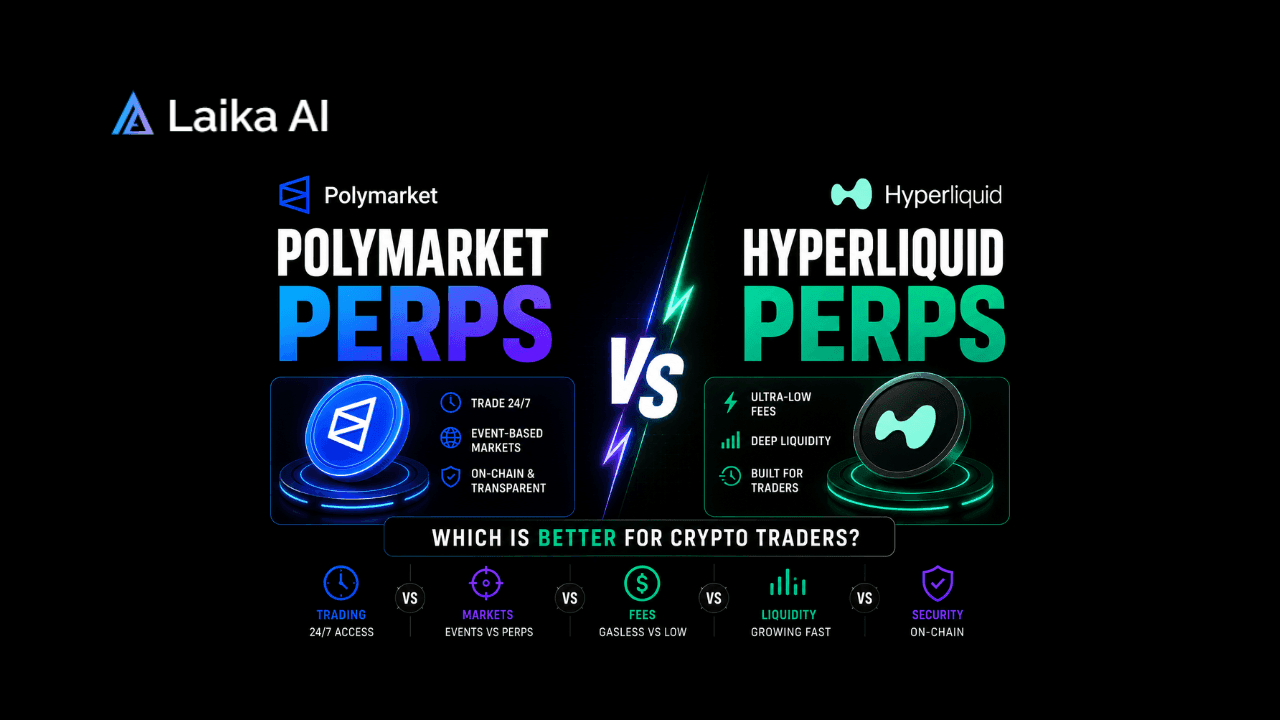
Polymarket Perps vs Hyperliquid is a comparison that didn't exist a year ago. Polymarket built its name on binary yes/no shares that resolve on a fixed date, while Hyperliquid grew into one of the largest on-chain perpetual exchanges by trading volume. That gap closed on April 21, 2026, when Polymarket launched its own perpetual futures product, putting leveraged, no-expiry trading on the same platform traders already use for event markets.
This guide compares Polymarket Perps and the Hyperliquid exchange on mechanics, fees, leverage, and the range of markets each one covers, so you can decide which platform fits the way you actually trade. If you're new to the product itself, Polymarket Perps: How to Trade Perpetual Futures on Polymarket walks through account setup and order types in more depth.
What Are Polymarket Perps?
Polymarket Perps is a perpetual futures product built alongside Polymarket's standard event markets. Unlike regular Polymarket shares, which pay out $1 or $0 once an event resolves, perps track a price continuously and never expire.
Here's what defines the product
- No expiration date. Positions stay open as long as margin covers them.
- Long or short. Traders can bet on price increases or decreases.
- Leverage. Reported caps run up to 20x during the current beta.
- Funding rate. A recurring payment, roughly every 8 hours, keeps the perp price anchored to spot.
- 24/7 trading. Positions, funding, and liquidations continue through weekends and outside market hours.
At launch, coverage centered on assets traders already track closely, including Bitcoin, Ethereum, gold, and a handful of major equities and indexes. Polymarket has signaled the product may eventually extend the same mechanics to event-outcome probabilities, letting a trader express a leveraged view on an election or macro release the way they'd trade a token price today. Exact asset coverage is still expanding, so checking the live perps tab before assuming a specific market is listed is the safer approach.
Because the product only launched a few months ago, its track record is short compared to established venues. That's worth weighing before sizing a position, and it's the reason a lot of the early coverage on this product frames it as an experts-only tool rather than a starting point for new traders.
What Is Hyperliquid?
Hyperliquid is a decentralized perpetuals exchange running on its own layer-1 blockchain, built around a fully on-chain central limit order book rather than the pooled liquidity model used by AMM-based DEXs. That structure lets Hyperliquid support limit orders, stop-losses, and leverage that behave like a centralized exchange, while funds stay in the trader's own wallet the whole time.
Hyperliquid perpetuals cover a much wider asset list than Polymarket Perps does today. The exchange lists hundreds of perpetual pairs spanning majors like BTC and ETH down to long-tail tokens, and it has expanded into equity-linked and commodity-linked perpetuals through its builder-deployed markets framework, HIP-3. Leverage on Hyperliquid perpetuals goes up to 50x on BTC and ETH, though it's capped lower on smaller-cap assets, and experienced traders generally use a fraction of the available maximum.
Hyperliquid also runs its own prediction-market primitive, HIP-4, which puts event contracts on the same matching engine as its perpetuals. That's the mirror image of what Polymarket is doing: Polymarket added perps to a prediction market, and Hyperliquid added prediction markets to a perps exchange. The official fee schedule and product documentation are worth checking directly at hyperliquid.xyz before trading, since tiers and available markets change frequently.
Polymarket Perps vs Hyperliquid: Core Differences
This comparison really comes down to which product each platform built first, and what that history still shapes today.
A useful way to frame it: Hyperliquid vs Polymarket isn't really a choice between two versions of the same tool. It's a choice between a mature perps exchange that recently added event contracts, and a mature prediction market that recently added perps. Each platform's newer feature inherits less liquidity and a shorter track record than its original product.
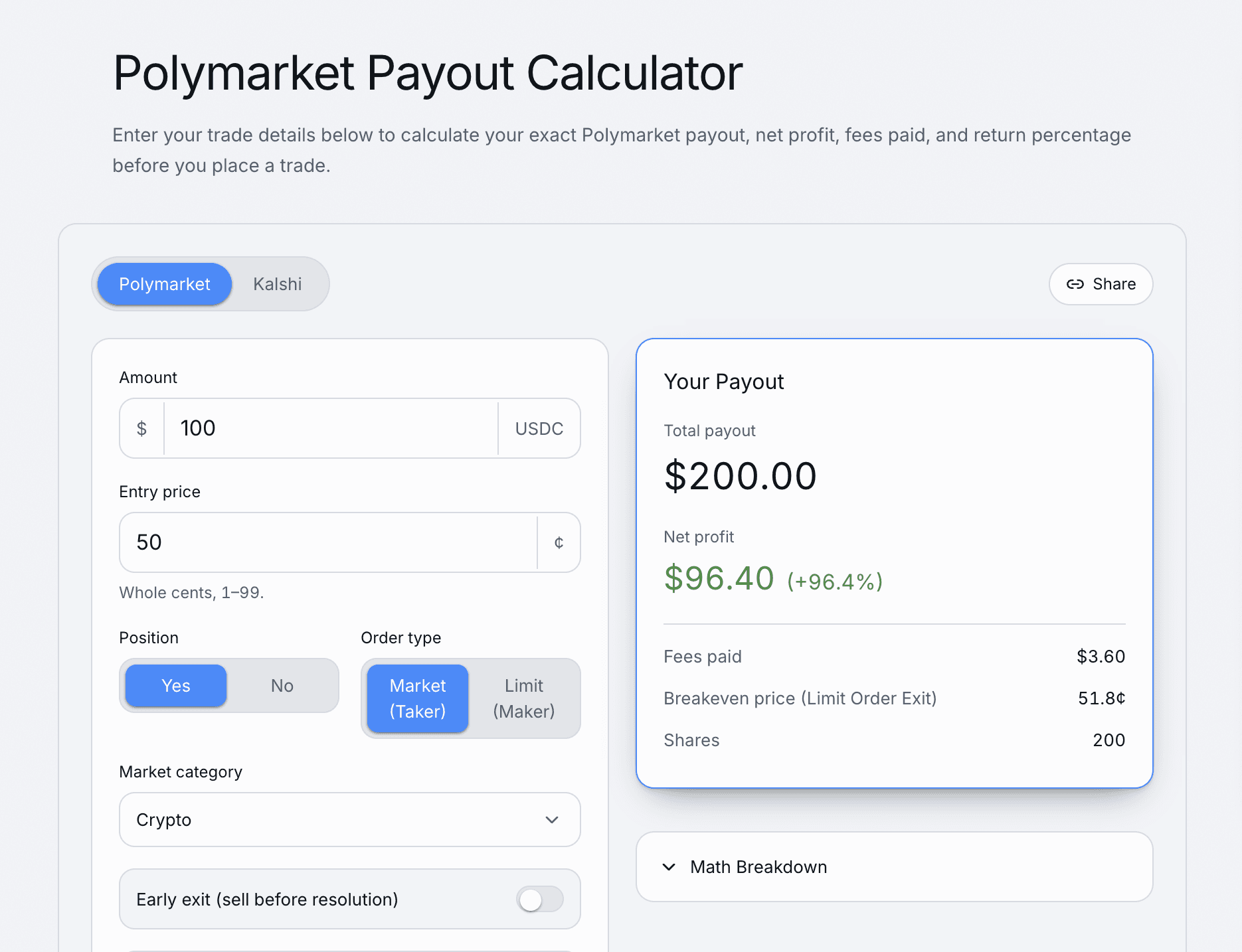
Try the Free Polymarket Payout Calculator → Calculate Your Profit Before You Trade
Fees Compared: Hyperliquid Fees vs Polymarket Perps
Hyperliquid fees follow a published, volume-based schedule. The base tier charges 0.045% on taker orders and 0.015% on maker orders for perpetuals, with rates stepping down as 14-day rolling volume increases, and maker rebates kicking in at the highest tiers. Spot trading carries a separate, slightly higher schedule. Withdrawals cost a flat 1 USDC.
Polymarket Perps has not published a full, granular fee table the way Hyperliquid has. Early coverage describes a maker rebate paired with a taker charge on notional value, consistent with how Polymarket's standard markets already work, where limit orders that add liquidity pay no fee and can earn a share of a rebate pool, while market orders pay the full taker rate. For up-to-date figures on either platform, checking Polymarket's own documentation at polymarket.com is more reliable than any third-party estimate at this stage.
For a broader look at how fee structures affect prediction-market trading specifically, Prediction Market Fees in 2026: Kalshi vs Polymarket breaks down the standard-market side of this in more detail.
Leverage and Risk Management
Leverage is where the two products diverge most in practice, not just on paper.
On Hyperliquid, a 50x position on BTC means a roughly 2% adverse move liquidates the entire position. On Polymarket Perps, with leverage capped around 20x in the current beta, the math is somewhat less punishing but still unforgiving at the higher end. In both cases, funding costs compound over time and can erode a directional edge even if the underlying price never moves against the position outright.
A few practices carry across both platforms
- Pick the liquidation price first, then size leverage around it, rather than choosing a leverage multiple and hoping the price cooperates.
- Set a take-profit and stop-loss at the time of entry, not after a position starts moving.
- Treat funding as a real, ongoing cost, especially on multi-day swing positions.
- Reserve higher leverage for short, high-conviction windows around a specific catalyst rather than holding it for weeks.
Traders coming from Polymarket's standard markets and used to capped-downside binary shares should treat perps as a genuinely different risk profile, closer to what's covered in Manual vs. Automated Arbitrage on Polymarket than to a typical event-contract trade. A standard Polymarket share caps the maximum loss at the price paid; a leveraged perp position does not, and a fast move against the position can wipe out the full margin in seconds.
It's also worth separating perpetual futures from other leveraged prediction products already on the market. Kalshi's own leveraged event contracts work on a different mechanism entirely, and Kalshi Perpetual Futures (Timeless) Complete Guide 2026 is a useful reference for traders comparing that structure against what Polymarket and Hyperliquid are each building.
Market Range and Asset Coverage
Asset coverage is the clearest practical difference between the two platforms today.
Hyperliquid's list runs into the hundreds, covering everything from BTC and ETH down to long-tail tokens, plus a growing set of equity and commodity perpetuals added through its builder framework. That framework has let outside teams stand up perpetual contracts linked to things like the Nasdaq-100 and individual large-cap stocks, expanding well beyond crypto-native pairs. Polymarket Perps, still in beta, covers a narrower set: major crypto assets, gold, and a handful of large-cap equities and indexes, with company messaging suggesting the list will grow as the product matures.
There's also a structural difference worth noting. Hyperliquid's asset list grew partly through third-party builders deploying their own markets against a staked bond, which is how it scaled so quickly past a few dozen pairs. Polymarket's list, by contrast, is curated directly by the platform for now, which keeps the catalogue smaller but arguably more consistent while the product is new.
If a trader specifically wants exposure to a low-cap token perpetual, Hyperliquid is currently the only one of the two that offers it. If the goal is combining perps with Polymarket's existing event-market catalogue in a single account, Polymarket Perps has the advantage of shared infrastructure, even with a smaller current asset list. Anyone weighing the platforms against a third option, rather than each other, may find Polymarket vs Kalshi: Which Is Better for Crypto Markets? a useful companion read, particularly if regulatory status matters as much as product mechanics.
Which Platform Should You Use?
Neither platform is a strict upgrade over the other, and the right pick depends on what a trader is actually optimizing for.
Hyperliquid makes more sense for traders who want the widest possible asset list, higher leverage ceilings, and a multi-year track record behind the execution engine. It's the more mature product, with deeper liquidity and a published fee schedule that's easy to model in advance.
Polymarket Perps makes more sense for traders already active in Polymarket's event markets who want to add leveraged, continuous-price exposure without leaving that ecosystem. The trade-off is a shorter track record, a narrower asset list, and less fee transparency while the product is still in beta.
Whichever platform ends up being the primary venue, using a properly secured wallet matters more with perps than with standard event contracts, given the added liquidation risk. Best Polymarket Wallets 2026 covers the setup options worth considering before funding a leveraged account. And for context on how quickly this space is moving, What the $15 Billion Polymarket Valuation Actually Means for Retail Traders looks at what the platform's growth could mean for products like this one going forward.
FAQ
Is Polymarket or Hyperliquid better for perpetuals trading?
It depends on priorities. Hyperliquid offers a wider asset range, higher leverage caps, and a longer operating history, making it the more established choice for pure perpetuals trading. Polymarket Perps offers tighter integration with Polymarket's event markets and is better suited to traders who already trade there and want leveraged exposure in the same account, accepting a newer, less proven product in exchange.
How does Hyperliquid compare to Polymarket?
Hyperliquid vs Polymarket comes down to what each platform started as. Hyperliquid began as a perpetual exchange and later added prediction markets through HIP-4. Polymarket began as a prediction market and later added perpetual futures. Each platform's core product has more liquidity and a longer track record than its newer addition.
What are Hyperliquid's fees?
Hyperliquid fees on perpetuals start at a base tier of 0.045% for taker orders and 0.015% for maker orders, with rates decreasing as trailing 14-day volume rises. Funding settles roughly hourly, and withdrawals cost a flat 1 USDC. Exact current tiers should be checked against Hyperliquid's own fee schedule, since they're periodically updated.
What are Hyperliquid perpetuals?
Hyperliquid perpetuals are leveraged, no-expiry contracts traded on Hyperliquid's on-chain order book. They cover hundreds of assets, from major cryptocurrencies to long-tail tokens, plus equity- and commodity-linked perpetuals added through the platform's builder-deployed markets framework.
How do Polymarket and Hyperliquid fees compare?
A polymarket vs hyperliquid fees comparison currently favors Hyperliquid on transparency: its schedule is fully published and volume-tiered, while Polymarket Perps' exact rates are still being finalized during beta. Both use a maker/taker model where limit orders that add liquidity cost less than market orders that take it, and Polymarket's version also carries a maker rebate similar to its standard event markets.
What are traders saying about Polymarket Perps?
Searches for polymarket perps reddit mostly turn up discussion focused on the product's short track record and the risk of using high leverage on a newly launched perps engine. Common advice mirrors standard risk management for any new leveraged product: start with low leverage, treat funding as a real cost, and confirm liquidation price before entering a position.